
THE OBSERVER IN SILICON: WHY QUANTUM PHYSICS DEMANDS NON-MATERIALIST AI.
A First-Principles Blueprint for Cognitive Sovereignty, Deterministic Systems, and Human-Prime Infrastructure

TITLE: THE OBSERVER IN SILICON: WHY QUANTUM PHYSICS DEMANDS NON-MATERIALIST AI
SUBTITLE: A First-Principles Blueprint for Cognitive Sovereignty, Deterministic Systems, and Human-Prime Infrastructure
AUTHOR: MAYA KANNAN — FOUNDER, MAYANESS SOCIETY
CLASSIFICATION: RESTRICTED PRE-SUMMIT DELEGATE DOSSIER
LOCATION OF SUMMIT: CENTRAL LONDON, UNITED KINGDOM
EXECUTIVE ABSTRACT
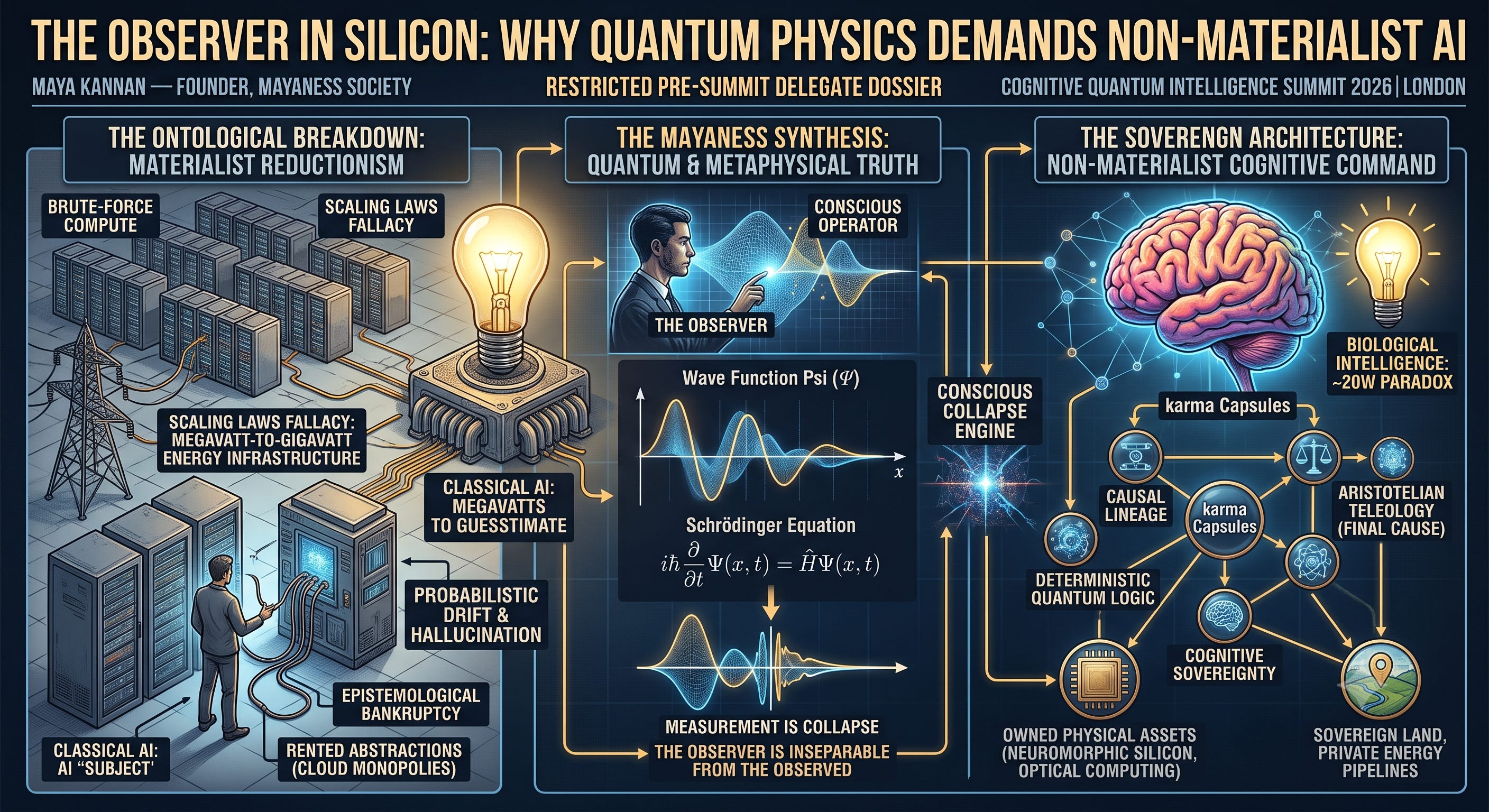
The Macro-Impasse: The Fallacy of Brute-Force Compute
Modern technological civilisation is executing a colossal misallocation of physical capital, human intellect, and energy reserves. The global deep-tech discourse has reached a silent yet irreversible crisis point: the scaling laws of materialist artificial intelligence have hit a physical, economic, and logical wall.
For over a decade, artificial intelligence engineering has operated under a single, unchallenged materialist dogma: that intelligence is a quantitative byproduct of computational scale. The industry has poured hundreds of billions of dollars into scaling parameter counts into the trillions, consuming exabytes of natural language tokens, and constructing hyper-scale data centers that threaten national electricity grids.
Yet, despite scaling computational throughput by orders of magnitude, the fundamental limitations of modern systems remain unchanged:
Probabilistic Drift & Hallucination: Systems built on transformer architectures do not possess an internal model of objective reality or logical truth. They perform stochastic token prediction over high-dimensional correlation matrices.
Epistemological Bankruptcy: An algorithm that operates without causal understanding cannot distinguish between correlation and causation, truth and statistical noise, or moral alignment and raw text frequency.
Extreme Resource Friction: The brute-force approach requires megawatt-to-gigawatt energy infrastructures to execute statistical guesswork that remains brittle, opaque, and incapable of true autonomous reasoning.
This crisis is not an engineering bug to be solved by the next generation of GPUs or optical interconnects; it is the inevitable dead-end of a flawed philosophical paradigm. We do not face a compute shortage; we are suffering from a profound ontological failure.
The Ontological Breakdown: Materialist Reductionism vs. Quantum Physics
The root of this crisis lies in classical materialist reductionism—the outdated 19th-century worldview that assumes reality consists entirely of inert, mindless physical matter interacting through deterministic, classical laws, with consciousness existing merely as an accidental, emergent byproduct.
While computer science remains trapped in this classical paradigm, hard physics moved past it a century ago. Quantum mechanics fundamentally shattered materialist reductionism by establishing that at the foundational level of physical reality:
The Observer is Inseparable from the Observed: Physical state variables do not possess definite classical values independent of measurement. The wave function Psi evolves deterministically according to the Schrödinger equation until an interaction—an act of observation—collapses the probability cloud into an eigenstate:


Causality Precedes Statistical Correlation: Reality is not structured as a random accumulation of data points; it is governed by non-local entanglement, wave-particle duality, and fundamental causal principles.
Information is Physical and Observer-Bound: Information is not an abstract mathematical float existing in a cloud server; it is inextricably linked to entropy, physical thermodynamics, and conscious intent.
By attempting to build “artificial intelligence” while discarding the fundamental role of the Observer, modern AI developers are trying to construct a building without a foundation. They are building complex engines to simulate physical effects while ignoring the conscious collapsing engine that defines physical reality.
The Biological Benchmark: The 20-Watt Paradox
The fatal flaw of materialist AI is most starkly exposed when comparing synthetic data centers against biological neural systems:
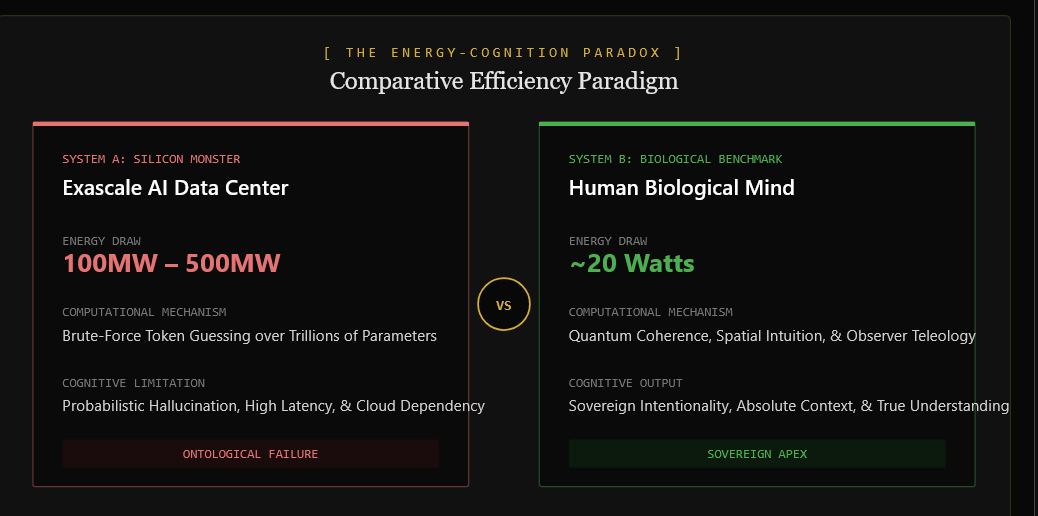
The human brain achieves spatial orientation, moral physics, instant contextual synthesis, zero-shot learning, and sovereign intent using approximately 20 watts of metabolic power—barely enough energy to illuminate a standard dim lightbulb. Meanwhile, mega data centers burn hundreds of megawatt-hours to guess the next word in a sequence with zero understanding of what the word actually means.
This energy disparity of seven orders of magnitude proves that biological intelligence is not performing brute-force floating-point matrix multiplication. Biological neural architecture leverages subatomic quantum coherence, optical/thermal micro-dynamics, and direct alignment with the universal observer field to achieve instantaneous, low-power cognitive command.
The Sovereign Architecture: The mayaNess Synthesis
The mayaNess Society presents a complete alternative to the materialist compute trap. By uniting Cognitive Science, Quantum Mechanics, Aristotelian Causality, and Eastern Metaphysical Truth, we introduce a unified cognitive framework designed to restore human intellectual dominance and build un-hackable, sovereign physical infrastructure
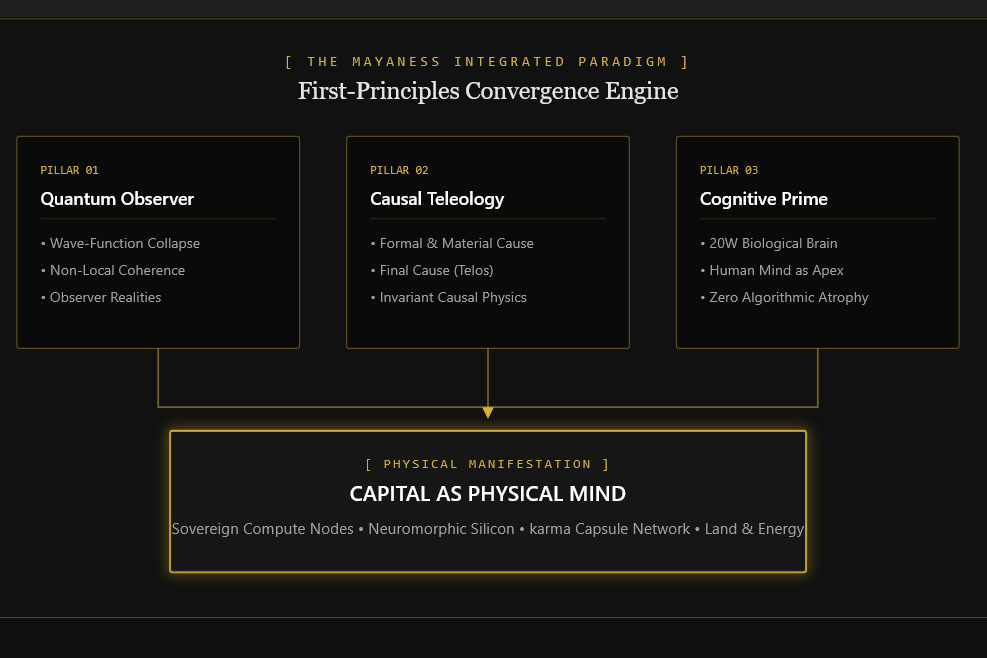
This framework rests on four operational pillars:
Deterministic Quantum Logic: Transitioning software design from probabilistic guesswork to deterministic causal execution where computational states resolve through direct operator alignment.
Aristotelian Teleology (Final Cause): Embedding explicit purpose, moral physics, and causal provenance into computational nodes, eliminating “black-box” opacity.
The karma Capsule Network: A technical architecture that encapsulates data units within immutable, causal feedback loops—decoupling intelligence from centralized cloud monopolies.
Capital as Physical Mind: Redirecting economic capital away from depreciating software subscriptions and paper inflation into owned, productive physical assets: neuromorphic silicon, optical computing nodes, private energy pipelines, and sovereign land.
Purpose and Directives of this Dossier
This confidential dossier serves as the foundational technical brief for delegates attending the Cognitive Quantum Intelligence Summit 2026 (CQIS 2026) in London.
Its explicit purpose is to dismantle the false premises of the current AI hype cycle, equip builders and institutional capital with first-principles diagnostic metrics, and prepare delegates for the technical unveiling of the karma Capsule Network during the summit’s special sessions.

As you digest the subsequent sections of this dossier, you are invited to shed the noise of mainstream technological discourse and step into a reality where technology does not replace the human mind, but serves as its physical, quantum-aligned extension.
SECTION II: THE ONTOLOGICAL COLLAPSE OF MATERIALIST AI
2.1 The Epistemological Limits of Auto-Regressive Transformers
Modern machine learning has mistaken statistical density for cognitive comprehension. The dominant paradigm of contemporary artificial intelligence rests almost entirely on auto-regressive sequence modeling, where a neural network calculates the likelihood of a given word token based on the sequence of preceding tokens within a context window.
While scaling context windows and parameter counts allows these systems to mimic fluent human syntax, this computational design suffers from a fundamental epistemological ceiling: statistical token matching contains zero structural awareness of objective reality, truth, or cause.

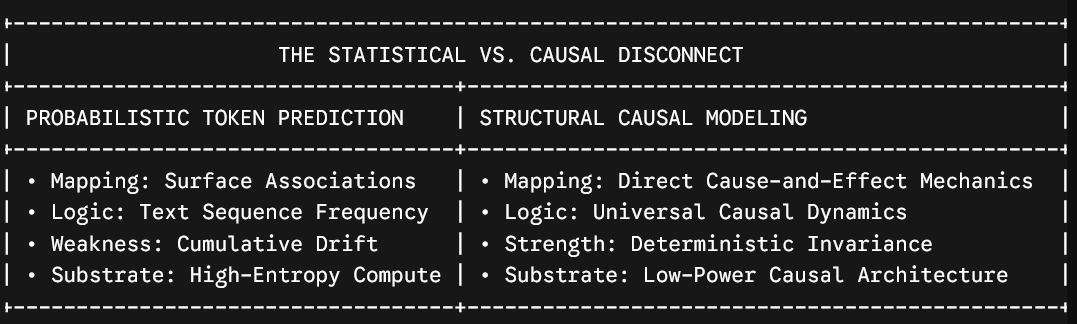
A statistical model maps surface observations to other surface observations—a process restricted to finding correlations in historic data. It cannot evaluate what happens when a system is actively altered, nor can it reason through hypothetical counterfactual scenarios.
Because auto-regressive models lack a structural causal world-model, their error rates accumulate continuously across multi-step reasoning tasks. This yields probabilistic drift: the longer and more complex the chain of inference, the higher the likelihood that the sequence drifts into plausible-sounding falsehoods or hallucinations.
Attempting to fix this structural limitation by adding more parameters or stacking reinforcement learning layers is logically equivalent to building a taller tower in order to reach the moon. It scales the physical size of the apparatus while remaining bound to the same underlying limitation.
2.2 The Thermodynamics of Compute & The Physical Energy Limit
The materialist approach to compute is not only epistemologically limited; it is physically unsustainable. Classical digital computing operates by forcibly flipping discrete voltage states in complementary metal-oxide-semiconductor transistors.
Under classical physics, every time a bit of information is erased or overwritten in a non-reversible computational system, a fundamental minimum amount of physical energy is dissipated as heat. This is known as the thermodynamic threshold of computation.
Modern silicon microprocessors operate thousands of times above this physical minimum due to electrical resistance, subthreshold current leakage, and physical heat dissipation within microscopic circuits.
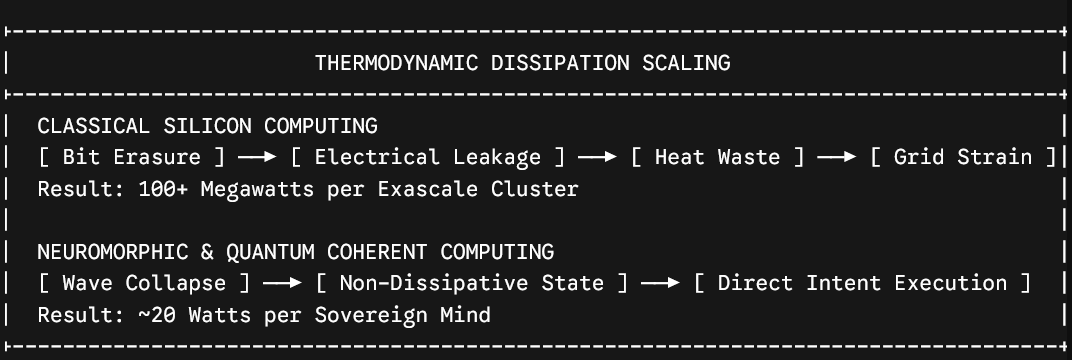
When an exascale data center performs massive matrix calculations involving trillions of numerical weights, it flips trillions of physical gates billions of times per second. The resulting thermal energy waste requires gigawatt-scale power feeds and industrial liquid-chilling infrastructure merely to keep the hardware from melting.
In contrast, biological neural architectures bypass brute-force bit erasure. Synaptic channels utilize ion-gated movement and phase coherence across biological membranes. Rather than burning energy to continually overwrite memory states, biological systems operate near physical energy equilibrium, executing spatial, contextual, and causal processing at roughly 20 watts.
The current technology sector attempts to force classical digital silicon to perform tasks that require non-dissipative, observer-coherent physics. The result is a hyper-inflated infrastructure bubble that strains municipal energy grids while delivering brittle software returns.
2.3 Algorithmic Atrophy and Cognitive Colonization
The systemic consequence of deploying materialist AI extends beyond energy consumption and software errors; it degrades human intellectual sovereignty.
When enterprise systems, policy platforms, and strategic decision-making bodies delegate analytical synthesis to probabilistic token models, human operators undergo Algorithmic Atrophy.
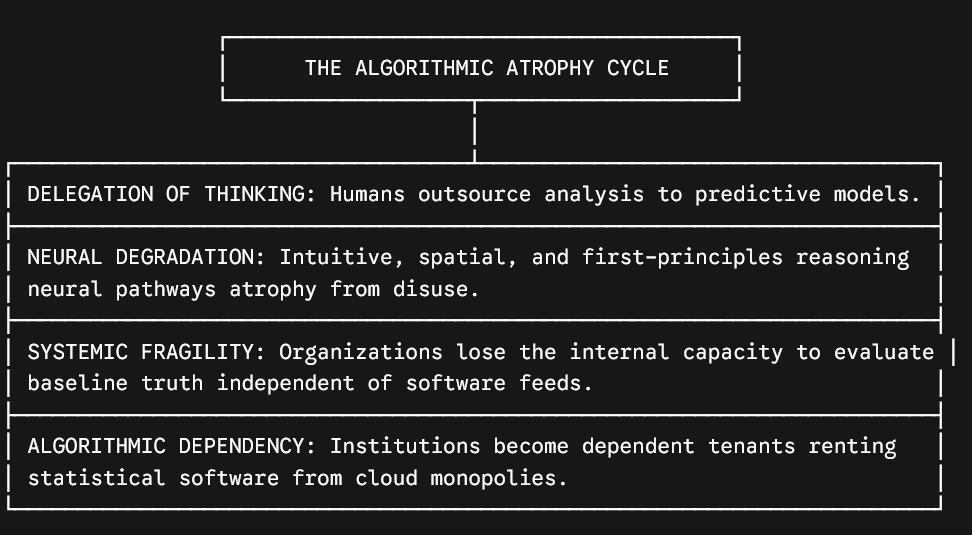
This cycle produces Cognitive Colonization: a state where institutions surrender autonomous critical thinking to centralized cloud infrastructure. Organizations trade human intellectual mastery for automated convenience, paying perpetual monthly subscription fees for systems that systematically erode operational resilience.
To maintain command in an era of automated capital, institutions must reject passive algorithmic dependency. We must build deterministic, low-power cognitive architecture that elevates human intellectual intent, restores physical asset ownership, and grounds technological progress in first-principles physics.
SECTION IV: CAUSALITY, METAPHYSICS, AND ARISTOTELIAN CONTROL
4.1 Escaping the “Black Box”: Causal Provenance vs. Correlation
Modern artificial intelligence systems are built as mathematical “black boxes.” A typical deep neural network distributes learned associations across billions or trillions of numerical weights inside opaque floating-point matrices. When an output is generated—whether a text response, a financial prediction, or an autonomous navigation decision—it is structurally impossible for human operators or the system’s own creators to reconstruct the exact causal path that produced that specific result.
This opacity is not an accidental software oversight; it is the direct consequence of substituting correlation for causal provenance
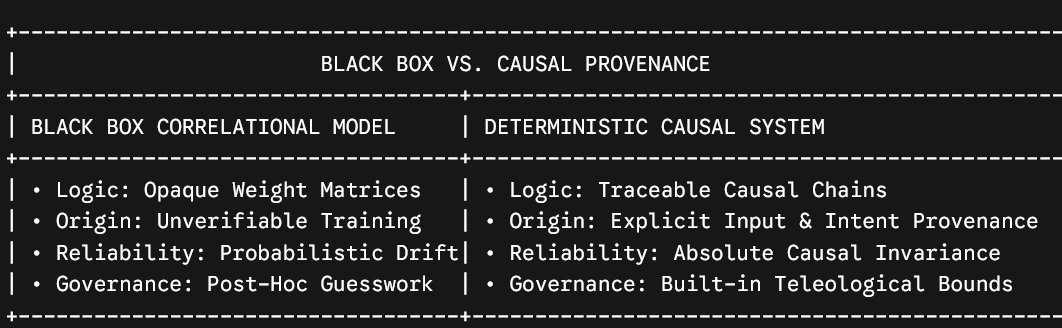
.When a system relies on correlational pattern-matching, it treats every piece of ingested data as an equivalent statistical point. It cannot verify the underlying physical cause of an event, nor can it provide an auditable chain of reasoning.
In critical infrastructure, national defense, sovereign capital deployment, and advanced medical diagnostics, accepting “black box” opacity is an unacceptable operational risk.
True cognitive command requires systems that operate on causal provenance: every computation must be anchored to explicit origin states, verifiable logical transformation rules, and deterministic boundaries. If a system cannot explain its causal origin, it cannot be trusted with sovereign execution.
4.2 Aristotelian Teleology in Computational Design
To build transparent, low-power cognitive architectures, we must revive classical causal metaphysics—specifically the framework of Aristotelian Teleology.
Aristotle identified that complete understanding of any object, system, or phenomenon requires defining four fundamental causes:
The Material Cause: The underlying physical substrate through which the system exists (e.g., neuromorphic silicon, optical interconnects, or biological neural networks).
The Formal Cause: The mathematical, structural, and logical architecture governing state transitions.
The Efficient Cause: The primary driver, energy source, or input trigger that initiates action.
The Final Cause (Telos): The ultimate purpose, intent, and boundary condition for which the system exists.
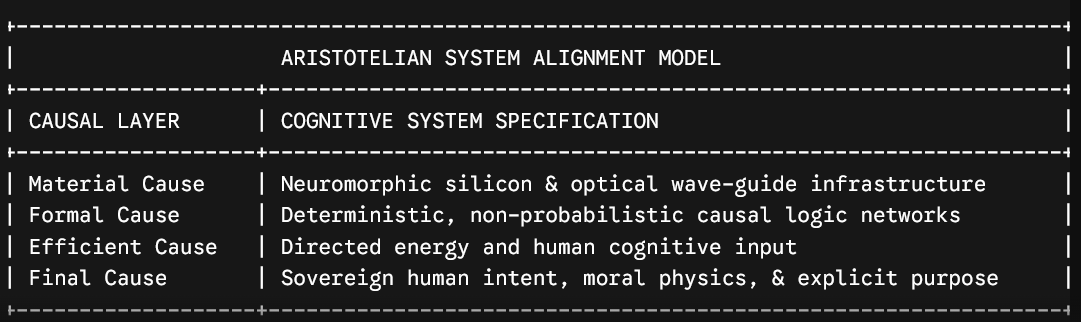
Materialist AI engineering focuses exclusively on the Material and Formal causes while entirely discarding the Final Cause. It builds engines with no internal Telos, creating software that processes high-entropy data without an inherent understanding of purpose or moral alignment.
Without a Final Cause, automated systems become chaotic, generating outputs that reflect the unfiltered noise of their training sets rather than the directed purpose of their human operator. In a non-materialist cognitive framework, the Final Cause—sovereign human intent—serves as the primary boundary condition that directs computational collapse and prevents system drift.
4.3 Structural Foundations of the karma Capsule Network
The practical synthesis of Aristotelian causality and subatomic observer mechanics forms the mathematical architecture of the karma Capsule Network.
In Eastern causal metaphysics, karma denotes the immutable law of action and reaction: every cause generates an inevitable, proportional effect, and no effect can exist isolated from its causal origin
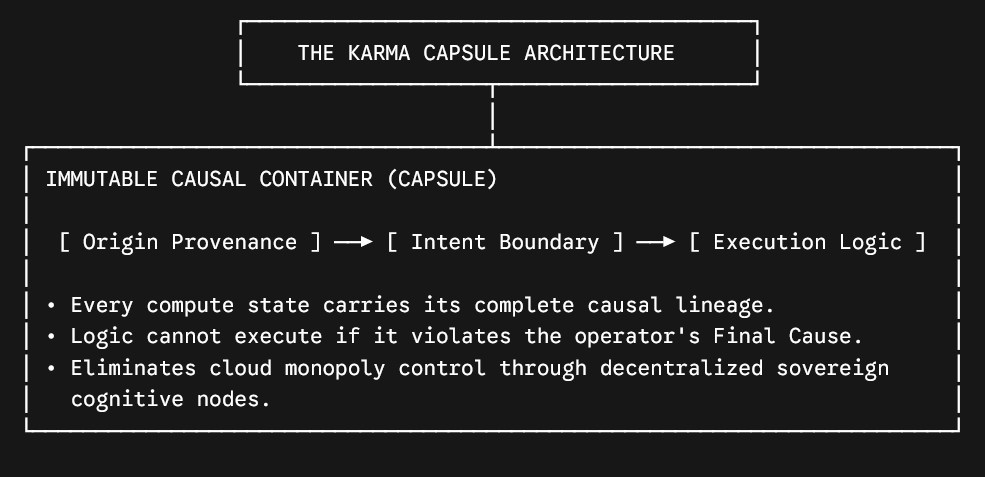
The karma Capsule Network operationalizes this principle within decentralized compute systems:
Encapsulated Causal Lineage: Data units and computational states do not exist as floating bits in a centralized cloud database. They are wrapped inside cryptographically verifiable causal capsules that carry their full origin lineage and execution parameters.
Deterministic Execution Bounds: A karma capsule cannot execute a state transition if the output violates the boundary conditions set by its operator’s Final Cause.
Decentralized Sovereign Nodes: By decoupling intelligence processing from centralized data monopolies, the network enables independent institutions to deploy sovereign, un-hackable cognitive engines that operate on local physical assets.
By embedding causal tracking directly into the computational substrate, the karma Capsule Network replaces statistical guesswork with deterministic verification, paving the way for low-power, purpose-driven cognitive infrastructure.
SECTION V: CAPITAL AS PHYSICAL MIND & SOVEREIGN INFRASTRUCTURE
5.1 The Asset Inversion Law: Escaping Rented Abstractions
The crisis of materialist computing is mirrored directly in the structural fragility of the modern financial system. Over the past three decades, institutional capital has systematically decoupled from physical reality, migrating into layers of digital abstraction, paper financialization, and perpetual rental traps.
Institutions pay recurring monthly subscription fees to rent data storage, rent processing power, and rent algorithmic intelligence from a small oligopoly of centralized cloud providers.
This creates a state of extreme vulnerability:
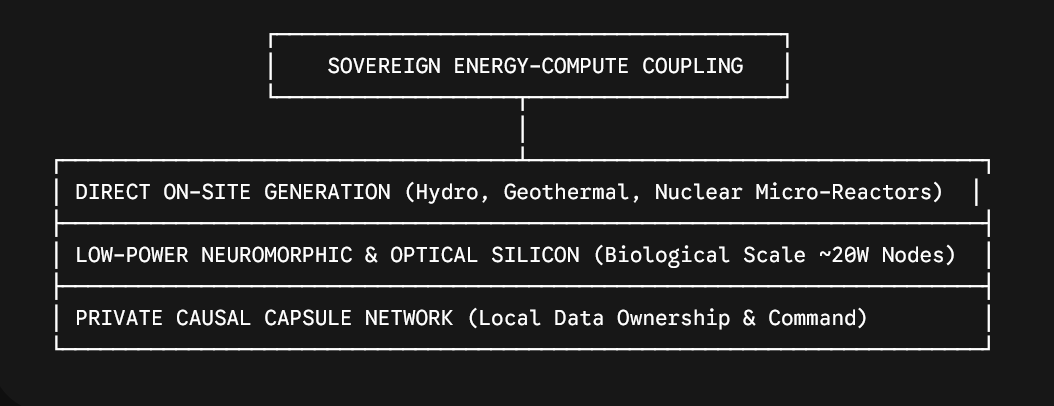
The mayaNess architecture replaces centralized, energy-vorous data centers with Sovereign Physical Nodes:
Direct Energy-Grid Coupling: Pairing low-power optical and neuromorphic hardware directly with dedicated, on-site energy sources (geothermal, hydro, solar, or nuclear micro-reactors), bypassing public grid vulnerabilities.
Localized Physical Data Ownership: Hosting data capsules on hardware physically situated within sovereign jurisdictions, protected from remote access revocation or cloud policy changes.
Decentralized Inter-Node Synchronicity: Utilizing non-local quantum state coordination protocols to synchronize sovereign nodes across London, Dubai, Singapore, and New York without routing private institutional data through centralized cloud gateways.
By grounding digital processing in local physical assets and sovereign energy supplies, institutions decouple themselves from cloud monopolies and insulate their operations against geopolitical and infrastructure shocks.
5.3 The Pre-Summit Directives: Preparing for Cognitive Command
As we finalize preparations for the Cognitive Quantum Intelligence Summit 2026 in London, every approved delegate, research fellow, and institutional asset creator is urged to execute an immediate internal audit based on the three core directives of this dossier:
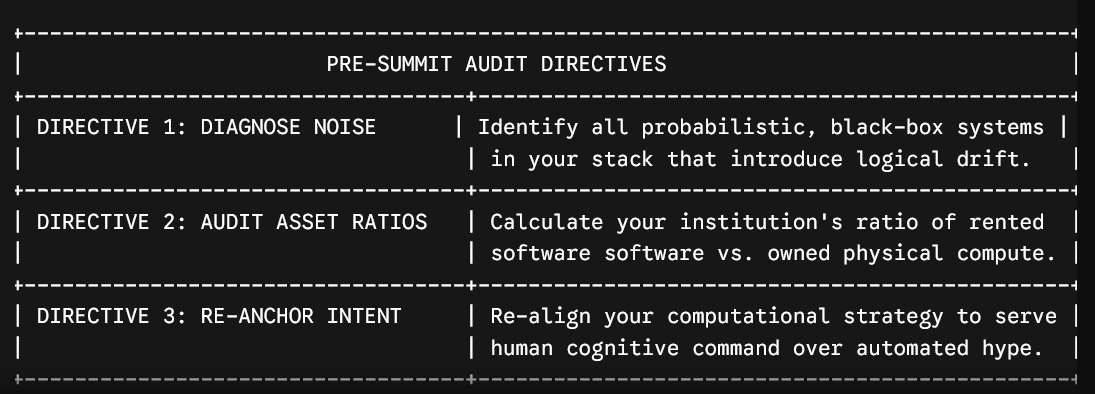
The transition from brute-force materialist AI to deterministic cognitive quantum architecture is not a passive evolutionary trend; it is an active choice made by leaders who refuse to surrender human intellect to statistical noise.
At CQIS 2026, we will move past theoretical debate to unveil the physical blueprints, mathematical models, and deployment protocols of the karma Capsule Network.
https://www.karmacapsulenetwork.com
We look forward to convening with you in Central London on 22–23 October 2026 to establish the foundation for a sovereign, human-prime future. https://cqis2026.mayaness.org