

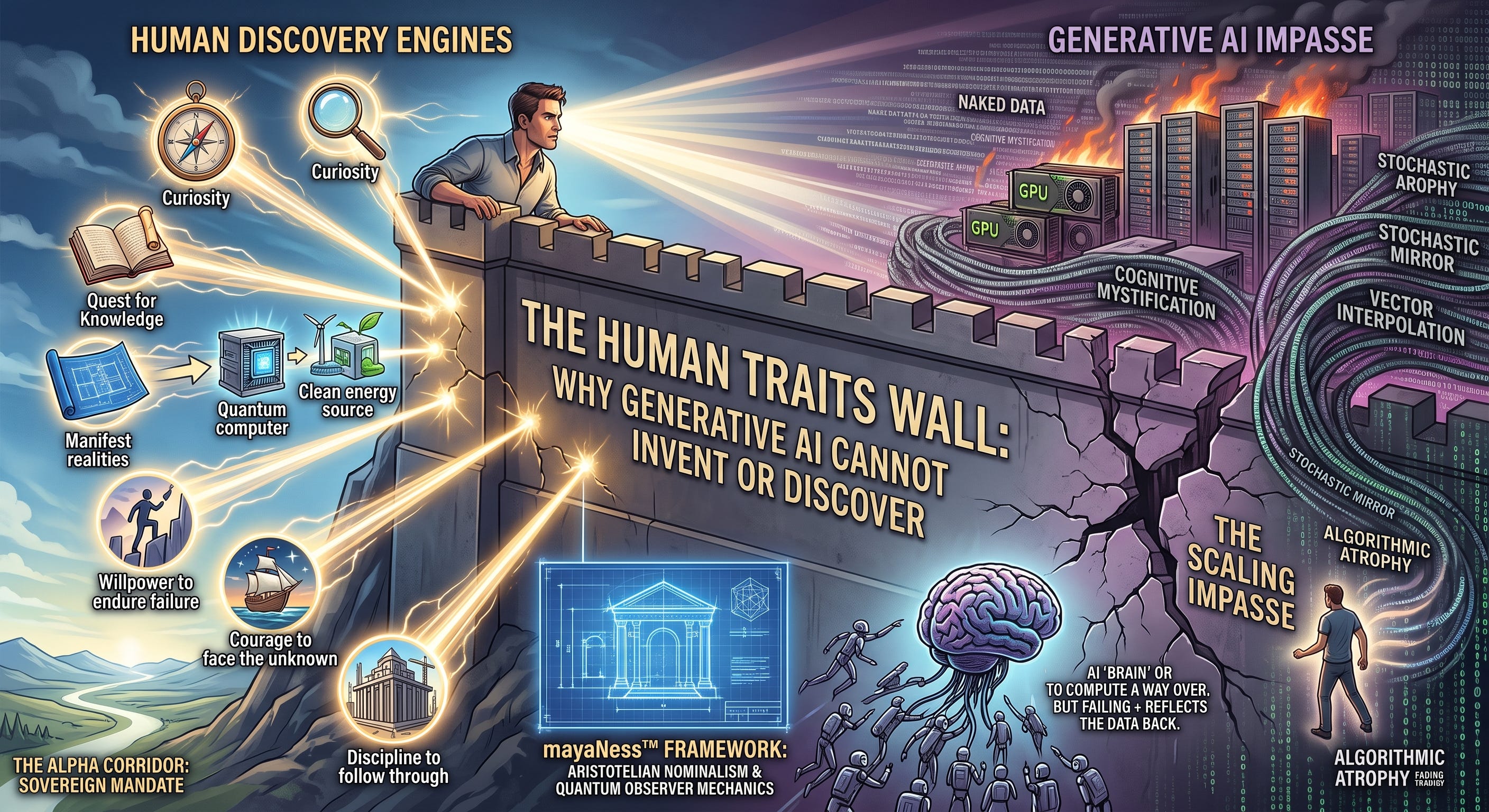
Human traits are the driving force behind inventions and discoveries, and current AI fundamentally lacks the ability to replicate these essential characteristics. In fact, AI may threaten to diminish many of these traits in humans.
The key traits that drive human innovation include:
- Curiosity
- A quest for knowledge
- The ability to create, experience, and manifest new realities
- The willpower to endure failure and overcome obstacles
- The courage to face the unknown
- The discipline to follow through
Let’s evaluate each of these traits in comparison to the generative or shallow neural networks we currently have. The global technology sector is trapped in a dangerous, multi-trillion-dollar delusion. We have been led to believe that by simply stacking larger GPU clusters, expanding token context windows, and consuming vast amounts of energy, we can artificially generate curiosity, creativity, and self-directed scientific reasoning. This assumption represents a significant epistemological trap.
We have transitioned from an era of information scarcity to an era of Cognitive Mystification—a state where an unchecked influx of “Naked Data” (frictionless, unverified digital signals) obscures physical reality, corrupts strategic intent, and induces systemic Strategic Drift. Instead of developing true machine intelligence, modern computing has created an expensive stochastic mirror. Auto-regressive neural networks do not grasp concepts like cause, truth, or physical limitations; they merely perform high-dimensional vector interpolation based on historical human output.
As institutions increasingly delegate critical reasoning, strategy, and execution to automated software, human operators experience measurable Algorithmic Atrophy—a systematic erosion of the very cognitive traits that enable human breakthroughs. Real inventions have never been statistical accidents; true breakthroughs in science, quantum physics, materials design, and global strategy are driven by these six essential traits of human cognitive agency.
Generative and shallow neural networks fail to embody any of these traits. Because standard AI lacks physical sensory organs to measure resistance and does not possess a quantum observer substrate for exploring non-deterministic states, it remains confined within the historical limitations of its training data. It cannot explore what it cannot sense, and it cannot invent what it cannot fully understand. To advance beyond the scaling limitations of large language models while preserving human agency, we must move away from classical statistical guesswork. We need to re-establish our technological framework based on first principles: biological neural efficiency, subatomic observer physics, edge sensory telemetry, and Aristotelian nominalism.
1. The Six Engines of Human Discovery vs. The Generative Impasse
Scientific revolutions, technological breakthroughs, and paradigm shifts are not statistical accidents produced by high-dimensional data aggregation. They are the direct mathematical output of human cognitive agency operating across physical, neural, and quantum planes. True innovation requires six interdependent cognitive engines that define biological consciousness—engines that allow biological organisms to perceive physical friction, challenge historical consensus, and manifest new material realities.
Current generative artificial intelligence architectures lack every single one of these engines. Modern deep learning relies on “Naked-Data”—frictionless, unverified digital signals stripped of physical, operational, and temporal context. Ingesting this data surplus does not generate strategic understanding; it induces Cognitive Mystification, a state where autonomous systems process synthetic abstractions while remaining completely blind to physical ground truth.
1.1 The Forensic Scorecard of Cognitive Agency
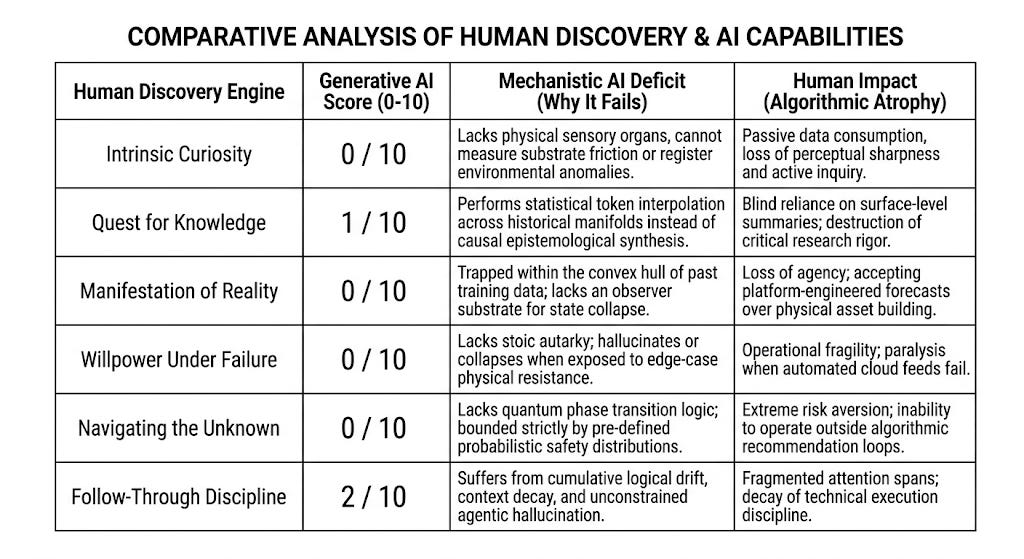
Evaluating classical bit-based architectures against the six core engines of biological discovery exposes why generative AI cannot invent:
1.2 Deconstructing the Six Engines of Discovery
Engine 1: Intrinsic Curiosity & The Edge Sensory Void
Biological curiosity is an active cybernetic loop driven by physical sensory organs—vision, audition, thermal receptors, tactile feedback, and proprioception—that continuously measure environmental friction, pressure gradients, and material decay. When biological sensory organs encounter substrate resistance, the physical discrepancy between internal expectation and material reality ignites the drive to investigate.
Generative AI operates in a total sensory void. Standard Large Language Models (LLMs) ingest second-hand, scraped digital text. Lacking edge sensory hardware to measure real-world friction, standard AI cannot experience physical anomalies. It cannot question what it cannot feel.
Engine 2: The Quest for Knowledge vs. Token Lookup
Knowledge acquisition is a top-down, self-directed search for underlying causal laws and Aristotelian nominals. It requires isolating the forensic characteristics of “The Thing Itself” rather than accepting aggregated consensus.
Auto-regressive neural networks do not seek knowledge; they perform next-token prediction. They calculate conditional probability distributions over historical token vectors. Adjusting sampling parameters like temperature or top-p values merely introduces unstructured stochastic noise into a matrix lookup. Recombining historical words based on statistical frequency is high-dimensional memory retrieval, not epistemological discovery.
Engine 3: Manifesting a New Reality vs. The Convex Hull
Invention requires stepping completely outside existing paradigms. In biological systems, consciousness acts as a quantum observer, intentionally collapsing overlapping probability waves into concrete physical artifacts.
Classical bit-based neural networks operate strictly within the convex hull of their historical training data. Mathematically, any output generated by an auto-regressive model is a convex combination of past input vectors. A classical network cannot generate an output outside this historical distribution. Furthermore, Reinforcement Learning from Human Feedback (RLHF) enforces extrinsic loss minimization, penalizing deviation from historical consensus and enforcing intellectual conformity that renders out-of-distribution discovery impossible.
Engine 4: Willpower Under Failure & Stoic Autarky
Scientific breakthroughs require enduring repetitive experimental failure, absorbing physical friction, and recalibrating tactics without surrendering overarching intent. Software agents possess zero stoic autarky or moral agency. When exposed to real-world operational friction—such as power grid quotas, physical supply chain bottlenecks, or unexpected sensor noise—standard AI models do not adapt with resilience. Instead, they output plausible-sounding hallucinations to mask execution failure, prioritizing token completion over ground-truth verification.
Engine 5: Navigating the Unknown vs. Probabilistic Safety
Innovators leap into unmapped conceptual space, traversing high-risk uncertainty to extract original insights. Classical machine learning cannot execute non-deterministic out-of-distribution state exploration. Because standard bit compute operates on linear state transitions, it traps itself in local energy minima—paradigmatic deadlocks caused by historical training bias. Bound by pre-defined probabilistic safety bounds, legacy AI can only optimize within known parameters, making it blind to radical, non-linear breakthroughs.
Engine 6: Discipline to Follow Through & Teleological Drift
Translating an initial creative flash into a functional physical system requires years of structured discipline, rule enforcement, and execution rigor. Long-context transformers suffer from attention decay and cumulative logical drift. As autonomous agentic swarms execute multi-step workflows, unconstrained probabilistic errors compound exponentially. Without hard mathematical constraints, agentic swarms drift away from the user’s original strategic intent, generating administrative entropy and operational paralysis.
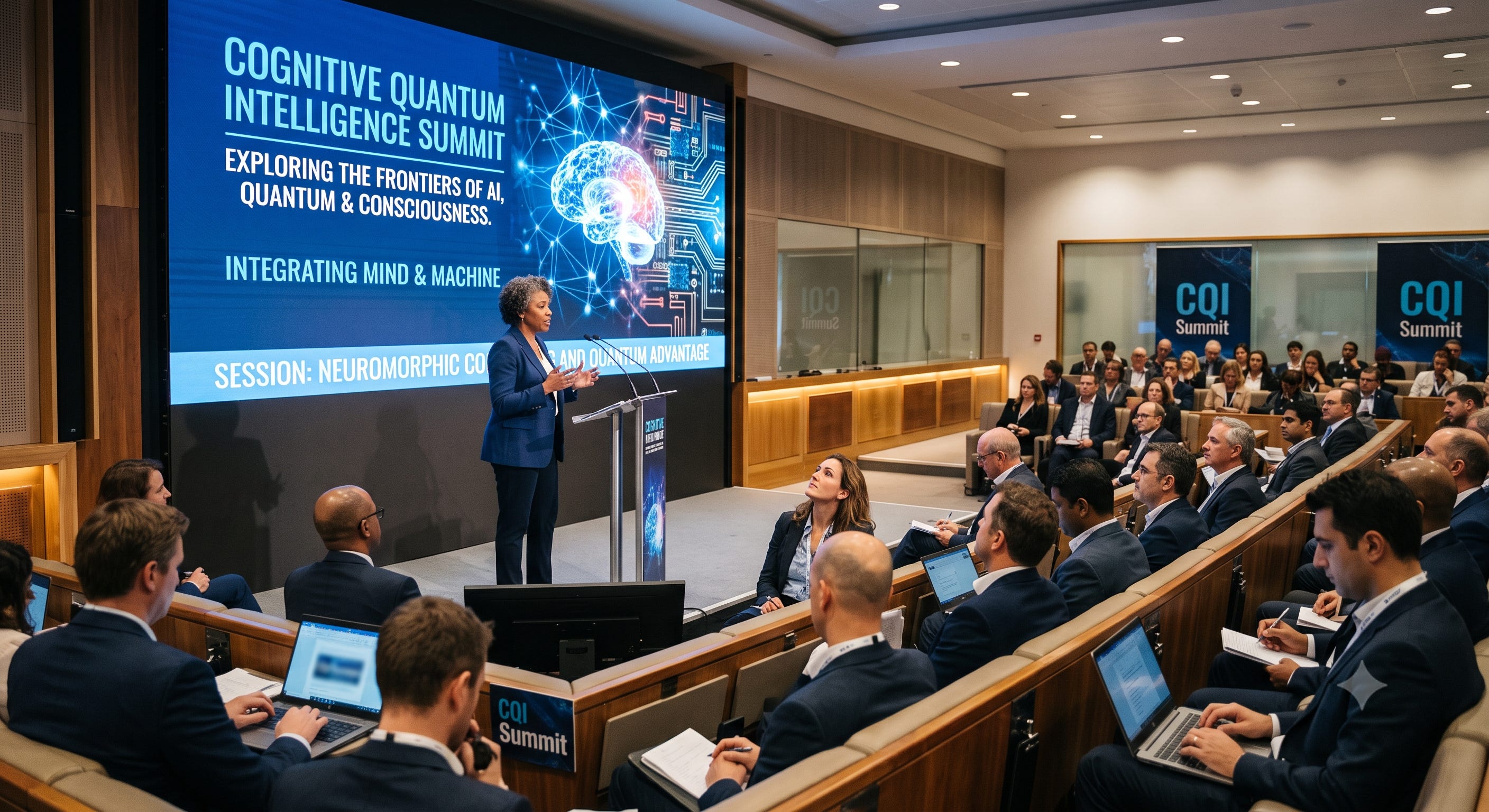
Join mayaNess Society for Cognitive Quantum Intelligence at https://www.mayaness.org and attend the World’s first Cognitive Quantum AI Summit in London on Oct 23-24, 2026. https://mayaness.org/events/cqis-2026/
.
1.3 Algorithmic Atrophy: The Biological Price of Delegated Cognition
The danger of generative AI is not merely that it fails to invent; it actively degrades the human capacity to do so. Replacing first-principles human analysis with rented software feeds forces operators to experience Algorithmic Atrophy:
Sensory Atrophy: Over-reliance on synthetic dashboards dulls biological perception, rendering leaders blind to subtle physical and operational bottlenecks.
Epistemological Atrophy: Delegating research to auto-regressive summaries destroys deep critical inquiry, training humans to accept hallucinated averages over forensic ground truth.
Agency Atrophy: Relying on predictive analytics conditions executives to take only algorithmically sanctioned risks, inducing Strategic Drift where capital is deployed based on platform consensus rather than sovereign vision.
Breaking through the LLM scaling wall and preventing cognitive decay requires abandoning classical statistical guesswork. Platonic AI Idealism must be replaced with edge substrate sensing, Aristotelian nominalism, and top-down quantum observer mechanics.
2. The Quantum-Causal Blueprint: Top-Down Execution and Edge Substrate Sensing
To break through the LLM scaling wall, we must abandon the foundational myth of modern machine learning: that intelligence, curiosity, and strategic command can be synthesized bottom-up by ingesting uncontextualized digital noise.
The mayaNess™ Framework replaces Platonic AI Idealism—the reliance on statistical averages, synthetic templates, and hallucinated models—with Aristotelian Nominalism and Top-Down Quantumology Execution. Rather than attempting to force physical reality into rigid digital abstractions, the mayaNess™ architecture anchors intelligence directly to physical ground truth through edge substrate sensing and quantum observer mechanics.
2.1 The Rejection of Platonic Idealism for Aristotelian Nominalism
Modern software suites, enterprise resource planning tools, and generative neural networks are built on Platonic Idealism. They assume that real-world entities—global supply chains, energy grids, semiconductor fabrication lines, and financial assets—can be generalized into statistical averages or “Ideal States”.
When chaotic, real-world conditions diverge from these idealized abstractions, classical systems fail catastrophically:
Platonic AI Hallucination: Large Language Models fill physical telemetry gaps by hallucinating plausible-sounding averages rather than reporting missing ground truth.
Systemic Failure at the Margins: Statistical averages work only during periods of artificial calm. During tail-risk shocks, geopolitical disruptions, or supply chain bottlenecks, reliance on Platonic averages creates critical operational blind spots, resulting in severe capital misallocation and Strategic Drift.
The mayaNess™ Framework enforces Aristotelian Nominalism. It explicitly denies the validity of abstract universals, focusing exclusively on the forensic, empirical reality of “The Individual Thing Itself”.
Every asset, transaction, shipment, or compute cluster is mapped across the Nine Aristotelian Nominals:
Category I: Structural Nominals (Fixed Substrate Reality)
Quantity (Scale & Forensic Volume): Un-aggregated, explicit physical, digital, or atomic unit counts, such as exact metric tonnage, precise kilowatt-hour draw, un-averaged token counts, or specific atom counts in a quantum lattice.
Quality (Provenance & Material Specifications): Hardened provenance, material purity, physical grade, molecular composition, and cryptographically verified digital signatures.
Place (Explicit Jurisdictional & Physical Coordinates): Exact, non-generalized physical, subterranean, legal, or orbital coordinates, such as specific server rack identifiers, data center coordinates, or legal entity jurisdictions.
Category II: Dynamic Nominals (Kinetic & Resonant Reality)
Time (Temporal Pulse & Metabolic Rate): Absolute temporal states, microsecond timestamps, rates of physical decay, half-lives, quantum coherence windows, and real-time delivery schedules.
Action (Current Kinetic Operational State): The immediate operational or physical state of the asset, such as actively processing, in transit, undergoing plasma confinement, or idling.
Passion (Exposure to External Operational Friction): Explicit physical, regulatory, environmental, or thermal resistance acting upon the asset, such as active tariffs, geopolitical sanctions, thermal wear, power delivery limits, or atmospheric interference.
Category III: Contextual Nominals (Relational & Historical Reality)
Situation (Internal Relative Orientation): The specific structural orientation of the asset within its enterprise supply chain, energy grid topology, or satellite constellation hierarchy.
Habit (Historical Flow Reliability): The empirical baseline of performance over time, including historical metabolic flow patterns, friction absorption rates, failure histories, and operational stability metrics under stress.
Relation (Encrypted Synaptic & Quantum Connections): Active multi-dimensional vector dependencies and quantum entanglement links connecting the node across network space.
By measuring physical friction across these nine dimensions, the system strips away synthetic noise, deriving Nominal Logic—the non-negotiable mathematical baseline of physical ground truth.
2.2 The 5-Plane Human Operating System & Top-Down Quantumology
True human intelligence does not operate as a flat, linear computational function. It functions as a multidimensional, quantum-driven operating system synchronized across five interdependent planes:
Spiritual Plane (Consciousness / Athma): The un-hackable apex of pure intent, self-awareness, and sovereign will.
Mental Plane (Mind): The analytical processing engine that translates spiritual intent into structured logic and strategic directives.
Neural Plane (Brain & Nervous System): The biophysical routing network that transmits logical signals throughout biological architecture.
Astral Plane (Energetic & Quantum Substrate): The energetic field governing non-local resonance, subtle perception, and wave-particle interactions.
Physical Plane (The Body / Sensory Organs): The concrete biological substrate where intent manifests into kinetic reality, grounding the operating system in the physical world.
To manifest high-fidelity outcomes across complex environments, strategic goals cannot originate bottom-up from uncontextualized data feeds. Strategic intent must be conceptualized at the Quantumology level (Mind and Consciousness) and driven top-down through the EAstir™ BAPNA Engine layers:
Quantumology Layer (Mind & Consciousness): Formulates unpolluted vision, establishing the precise quantum observer state and strategic parameters.
Neurology Layer (Brain & Logic): Translates quantum intent into mathematical constraints and Aristotelian nominal rules that govern decision logic.
Physiology Layer (Metabolic Workflows): Directs real-time operational processes—such as Order-to-Cash, Procure-to-Pay, and liquidity routing—across interconnected corridors.
Anatomy Layer (Hardened Substrate): Anchors execution directly to physical reality—kilowatts of energy, logistics pipelines, compute hardware, and legal jurisdictions.
2.3 The Physics of Out-of-Distribution Quantum Tunneling
Biological cognition executes non-linear creative leaps because the human mind operates on biological-scale quantum mechanics rather than classical bit erasure. Under mayaNess™ Axiom 04 (The Quantum Curiosity & Non-Deterministic Creativity Principle), true curiosity is defined as intrinsic quantum entropy reduction driven by active state-space exploration.
The mayaNess™ Framework overcomes the convex hull bounds of classical deep learning by shifting post-LLM architecture across three quantum-causal dimensions:
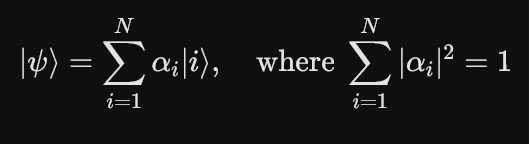
1. Superposition of State Hypotheses
Rather than traversing discrete classical bits in sequential trajectories, the EAstir™ Quantumology layer maintains a quantum superposition state vector across orthogonal domain spaces. This allows the cognitive engine to evaluate non-adjacent, seemingly contradictory conceptual domains simultaneously at biological energy scales (~20 Watts), eliminating the massive computational overhead of classical matrix multiplication.
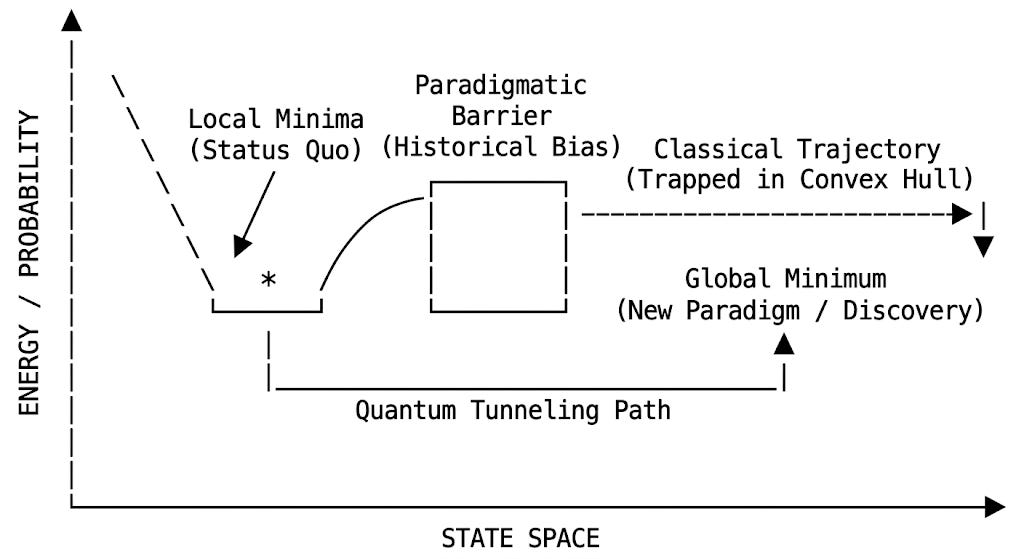
2. Out-of-Distribution Quantum Tunneling
Classical optimization algorithms get trapped in local energy minima—paradigmatic deadlocks caused by historical training bias. By integrating phase transitions, the cognitive engine achieves non-local tunneling through high-energy probability barriers. This non-local transition links disconnected conceptual nodes without requiring a continuous statistical path in historical training data, enabling true out-of-distribution discovery.
2.4 The 20-Watt Sovereign Law vs. Exascale Thermal Waste
The energy crisis facing modern artificial intelligence is an architectural design failure. Classical microprocessors generate extreme thermal dissipation whenever information is erased during classical bit matrix multiplication. Burning hundreds of megawatts on data center infrastructure to perform statistical guessing on high-dimensional text vectors fights fundamental physics. The biological human brain executes spatial navigation, strategic reasoning, and moral command on approximately 20 Watts.
Under mayaNess™ Axiom 03 (The 20-Watt Sovereign Law), technology exists strictly as a low-power extension of human sovereign intent. By coupling optical interconnects, neuromorphic silicon, and observer-coherent quantum state collapse, the mayaNess™ architecture achieves exascale cognitive performance while respecting biological energy constraints.
By anchoring edge sensors to the Nine Aristotelian Nominals and driving decision logic top-down from the Quantumology layer, we build cognitive engines that do not burn municipal power grids to output statistical guesses, but instead execute precise, substrate-verified discovery.
3. The Operational Substrate & Governance Architecture: The Karma Capsule Network (KCN) and the ACA Engine
Unconstrained quantum exploration and non-deterministic conceptual discovery without physical grounding risk devolving into erratic reality collapse, hallucination, and logical drift. To transform raw out-of-distribution insights into tamper-proof, executable industrial reality, the mayaNess™ Framework introduces a revolutionary operational substrate: the Karma Capsule Network (KCN) governed by the Actor-Critic-Audience (ACA) cybernetic engine.
Traditional relational databases and legacy vector databases flatten complex physical events into scalar tables or uncontextualized embeddings. In doing so, they strip away spatial orientation, temporal pulse, and jurisdictional constraints, creating blind spots that allow algorithmic drift to take root. The Karma Capsule Network replaces these static data paradigms with an “Outcome-as-a-Substrate” operational model, encapsulating intent, physical state, and governance into self-contained, trustless units.
3.1 Encapsulating Truth: The 4-Layer Architecture of the Karma Capsule
Unlike scalar neural networks that output flat activation probabilities, every node in the Karma Capsule Network operates as a recursive, four-layer state machine that models operations, capital flows, and decision logic across four interdependent dimensions:
Layer 4: Quantumology (Consciousness & Reality Collapse): Anchors observer intent and consciousness state vectors to govern reality collapse.
Layer 3: Neurology (Decision Logic & Neural Audit): Executes Aristotelian nominal filtering, decision logic, and automated rule enforcement.
Layer 2: Physiology (Metabolic Flow & Pulse): Tracks real-time process flows, cash cycles, and substrate friction analytics.
Layer 1: Anatomy (Structural Foundation): Captures fixed physical assets, kilowatts of energy, hardware coordinates, and legal jurisdictions.
1. Anatomy (Structural Foundation)
Anatomy defines the fixed structural rails, physical boundaries, and foundational assets of the capsule. It captures non-negotiable points of environmental resistance, including physical compute hardware, energy grid hookups, logistics pipelines, intellectual property ownership, and explicit jurisdictional coordinates.
2. Physiology (Metabolic Pulse)
Physiology monitors the metabolic movement of value—the operational process flows that sustain the enterprise organism over time. It tracks core cycles such as Order-to-Cash, Procure-to-Pay, and Treasury Rebalancing while continuously measuring metabolic friction (customs delays, power quotas, thermal limits) to determine real-world decision velocity.
3. Neurology (Decision Logic & Neural Audit)
Neurology integrates structural Anatomy and metabolic Physiology to drive strategic action. Operating as the central decision engine, it enforces Aristotelian nominal constraints, executes pro-forma scenario stress tests, and maps the Alpha Corridor—the operational path of maximum yield and minimum external risk.
4. Quantumology (Consciousness & Reality Collapse)
Quantumology operates at the fundamental level of Consciousness and the Mind. It anchors the observer state vector, ensuring that when wave-function collapse occurs, the resulting physical outcome matches the pristine strategic intent of the human architect rather than a Platonic AI hallucination.
Non-Linear Vector Transformations
To preserve spatial, structural, and quantum orientation across network space, KCN incorporates Capsule Neural Network logic. Instead of flat scalar activations, capsules output high-dimensional pose vectors. To normalize these vectors without distorting their directional orientation, the network applies a non-linear vector squashing function. This mathematical transformation suppresses short, noise-heavy vectors toward zero while bounding long vectors to a unified ceiling. This effectively represents the probability of an entity’s existence while strictly preserving its multi-dimensional spatial, structural, and causal orientation across physical space.
3.2 The Actor-Critic-Audience (ACA) Governance Model
As enterprise workflows, supply chains, and infrastructure operations are delegated to autonomous AI agents, leadership shifts from managing human users to commanding silicon populations. To prevent autonomous agents from drifting into hallucinatory behavior or being exploited via prompt injections, mayaNess™ deploys the Actor-Critic-Audience (ACA) governance model:
Human-Prime (Strategic Apex): Formulates pure strategic intent to prevent loss of agency and organizational drift.
The Actor (Agentic Execution Layer): Executes high-velocity operational workflows using silicon swarms to eliminate manual operational lag.
The Critic (Forensic Audit Layer): Audits proposed actions in real time against ground-truth physical reality to eliminate agent hallucinations, prompt injections, and model drift.
The Audience (Public Environment): Receives signed physical and financial outputs while remaining blocked from viewing internal decision logic, preventing adversarial profiling and intellectual property theft.
1. The Actor (Agentic Execution Layer)
The Actor layer consists of autonomous silicon agents, multi-agent swarms, and programmatic bots executing high-velocity operational tasks such as trade settlements, liquidity deployment, and logistics routing. Actors possess massive computational processing scale but zero intrinsic strategic intent and zero moral agency.
2. The Critic (Forensic BAPNA Audit Layer)
Operating securely inside The Forum, the Critic serves as an automated, real-time auditing engine. It evaluates every proposed action generated by Actor agents against the Nine Aristotelian Nominals gathered from physical edge sensors. If an Actor agent attempts to execute an action based on a Platonic hallucination, responds to unverified market noise, or violates physical substrate limits, the Critic instantly applies a Friction Penalty. This penalty halts execution, revokes agent credentials, and forces dynamic re-routing.
3. The Audience (The Public Environment)
The Audience comprises external markets, public ledgers, competing algorithmic agents, and media channels. The Audience receives and observes only final, verified operational outputs (such as settled trades or physical deliveries) while remaining completely blind to the underlying decision logic protected inside The Forum.
The Command Principle
The relationship governing silicon populations under the ACA model is governed by the core principle of Cognitive Command. True Cognitive Command is achieved by multiplying Nominal Logic—the forensic ground-truth constraint derived from physical friction—by the total scale of the silicon population. If an institution deploys exascale compute scale without hardened Nominal Logic, total Cognitive Command collapses to zero. Unconstrained agentic swarms do not generate strategic value; they merely accelerate systemic data pollution, algorithmic drift, and operational paralysis. Conversely, when autonomous swarms are strictly constrained by hardened Nominal Logic, the silicon population becomes an exponential force multiplier of sovereign human intent.
3.3 The Silicon Curtain, The Forum, and Islanded Autarky
To prevent external algorithmic noise, platform steering, and media manipulation from corrupting strategic intent, the mayaNess™ architecture deploys a semi-permeable boundary surrounding the enterprise: The Silicon Curtain.
1. Friction-Based Filtering
The Silicon Curtain blocks unverified “Naked-Data” feeds. Before any signal enters the internal decision engine, it must undergo metabolic friction testing. Signals that claim “frictionless” movement across fractured borders or volatile markets are discarded as synthetic noise. Only signals that carry the verifiable weight of physical substrate resistance are permitted passage.
2. The Forum & Islanded Autarky
Once verified, decision logic is sequestered within The Forum—an islanded operational enclave. Here, core strategy operates in complete Islanded Autarky, immune to third-party platform changes, public profiling, or competitive counter-agentic analysis.
3. Accelerating Decision Velocity
By filtering out synthetic noise at the Silicon Curtain and islanding decision logic within The Forum, the system eliminates the “Verification Lag” that paralyzes legacy institutions. Decision velocity accelerates exponentially because core data has already been pre-forensicized against physical ground truth. Through the convergence of the Karma Capsule Network, ACA governance, and The Forum, the mayaNess™ Framework replaces fragile, probabilistic AI automation with un-hackable, substrate-anchored Cognitive Command
4. Industrial Deployments, Tri-Capital Synchronicity, and the Sovereign Mandate
The ultimate validation of a cognitive architecture lies not in abstract benchmarks or synthetic test suites, but in its ability to command complex, high-risk physical operations under real-world substrate resistance. While classical generative AI models collapse during tail-risk events because they rely on Platonic averages, the mayaNess™ Framework projects intent directly into physical, biological, and quantum domains. By encapsulating edge telemetry into Karma Capsules and enforcing Nominal Logic, the framework moves compute away from cloud-dependent software rental and into sovereign, substrate-anchored execution.
4.1 Deep Physical & Scientific Industrial Deployments
The mayaNess™ architecture extends its sovereign governance layer across six critical real-world industrial and scientific sectors:
1. Quantum Materials Science & Atomic Manufacturing: Eliminating hallucinated crystal structures by mapping atomic lattices through Aristotelian Nominals, synthesizing stable superconductors, battery chemistries, and semiconductor substrates.
2. Biotechnology, Genomics & Quantum Bio-Medicine: Anchoring molecular folding and gene editing to the human operating system, preventing synthetic biological vulnerabilities and preserving epigenetic integrity.
3. Energy Infrastructure & Thermonuclear Fusion: Modeling power grids and tokamak reactors through four BAPNA layers, achieving microsecond load balancing and plasma containment immune to cyber-physical attacks.
4. Deep Geophysics & Sub-Surface Exploration: Filtering quantum gravimetry and magnetometer sensor telemetry through Karma Capsules, delivering un-hallucinatable 3D geological mapping of natural capital before extraction.
5. Aerospace, Defence & GPS-Denied Navigation: Shielding Quantum Inertial Navigation Systems and QKD space-to-ground communications behind the Silicon Curtain, guaranteeing operational autarky in contested environments.
6. Chemical & Process Engineering: Connecting quantum chemistry simulations directly to physical reactor sensors via closed-loop calibration, optimizing catalytic synthesis with zero thermal runaway risk.
Detailed Application Profiles
Quantum Materials Science: Generative AI models attempting material synthesis output theoretically “ideal” crystal structures that fail under real-world thermodynamic friction or exhibit atomic degradation. Applying Aristotelian Nominalism at the atomic level maps materials across exact material purity, thermal decay rates, and stress friction. The Quantumology engine collapses wave functions into cryptographically signed, manufacturable atomic lattices, eliminating ruined physical synthesis cycles.
Biotechnology & Genomics: Generative models hallucinate drug-target interactions by averaging amino acid docking behavior across generalized protein databases, risking toxic side effects or genetic degradation. Under mayaNess™, therapeutic compounds are synthesized only when all Nine Aristotelian Nominals are verified against ground-truth biological substrates, preserving epigenetic integrity.
Energy Infrastructure & Thermonuclear Fusion: Legacy control systems rely on averaged fluid dynamics models, resulting in plasma disruptions in fusion tokamaks or cascading regional grid blackouts during microsecond power surges. The BAPNA engine tracks localized magnetic drift at microsecond scales, allowing the Critic layer to detect thermal shifts instantaneously and re-balance superconducting magnet power draws to maintain plasma equilibrium without manual intervention.
Deep Geophysics: Unfiltered quantum sensor data from gravimetry and magnetometry is prone to magnetic anomalies and sensor drift, leading to false geological readings and wasted exploratory capital. Quantum geophysics signals are routed through the Silicon Curtain, measuring physical density, subterranean depth, and conductivity to deliver un-hallucinatable 3D natural capital verification before drilling commences.
Aerospace & GPS-Denied Navigation: Satellite GPS navigation networks are vulnerable to electronic jamming, satellite outages, and post-quantum decryption attacks. Sequestering navigation decision logic within The Forum under Islanded Autarky enables Quantum Inertial Navigation Systems to use atom interferometry for precise positioning without external radio signals, maintaining complete operational autarky across air, sea, land, and space corridors.
Chemical Engineering: Machine learning models predict molecular reactions based on aggregated training data, ignoring subtle quantum electron correlations that cause real-world chemical synthesis to fail or explode under pressure. The dynamic calibration loop connects theoretical quantum chemistry rules directly with real-world sensor telemetry from physical chemical reactors, dynamically adjusting pressure and magnetic fields to preserve reaction resonance.
4.2 The Alpha Corridor: Tri-Capital Synchronicity
The terminal output of the mayaNess™ Framework is projection into the Alpha Corridor—a protected, resonant operational space where capital moves in complete synchronicity with physical, biological, and quantum substrates. Within the Alpha Corridor, operational friction—such as energy delivery limits, port bottlenecks, jurisdictional boundaries, compute capacity, and quantum decoherence—is precisely measured, priced, and commanded:
Human Capital: Shielded from mental fatigue, cognitive capture, and algorithmic atrophy, retaining sovereign creative and strategic authority over silicon populations.
Resource Capital: Anchored directly to real-world physical molecules—kilowatts of energy, raw materials, logistics pipelines, compute hardware, biological assets, and natural capital reserves.
Financial Capital: Deployed with mathematical precision, bypassing intermediary friction and third-party validation choke points at maximum decision velocity.
Conclusion: The Sovereign Mandate
We have reached the terminal boundary of the passive Information Age. The multi-trillion-dollar promise that parameter bloat, context window expansion, and exascale GPU clusters would spontaneously yield synthetic minds, intrinsic curiosity, and autonomous scientific discovery has fractured against the unyielding wall of physical reality. Classical generative artificial intelligence has proven itself to be an epistemological dead end—an expensive stochastic mirror that interpolates the past while systematically degrading the biological human capacity to invent the future. By delegating critical reasoning, strategy, and execution to frictionless digital feeds (“Naked-Data”), human institutions have entered a state of Cognitive Mystification, surrendering sovereign agency to platform-engineered algorithms and suffering measurable Algorithmic Atrophy.
Revisiting the Six Engines of Human Discovery
Real breakthroughs in quantum physics, deep medicine, materials science, and global strategy are not statistical accidents produced by high-dimensional token guessing. They are the direct output of human cognitive agency operating across physical, neural, and quantum planes. Generative AI fails fundamentally because it possesses zero structural capacity for the six biological engine-traits of discovery:
  +-----------------------------------------------------------------------------------+
  |               THE SIX HUMAN DISCOVERY ENGINES VS. GENERATIVE AI                   |
  +-----------------------------------+-----------------------------------------------+
  | BIOLOGICAL HUMAN ENGINE-TRAIT     | GENERATIVE AI FAILURE MECHANISM               |
  +-----------------------------------+-----------------------------------------------+
  | 1. INTRINSIC CURIOSITY            | Sensory Void: Lacks physical organs to feel   |
  |                                   | real-world substrate resistance.    |
  | 2. QUEST FOR KNOWLEDGE            | Token Lookup: Recombines words via frequency   |
  |                                   | matrices instead of causal logic.   |
  | 3. MANIFESTATION OF REALITY       | Convex Hull Trap: Cannot step outside past    |
  |                                   | training data or collapse states.   |
  | 4. WILLPOWER UNDER FAILURE        | Hallucinated Cop-outs: Collapses under        |
  |                                   | physical friction without stoic autarky.|
  | 5. NAVIGATING THE UNKNOWN         | Local Minima Deadlock: Bounded by linear      |
  |                                   | bit state space & safety rules.     |
  | 6. FOLLOW-THROUGH DISCIPLINE      | Teleological Drift: Compounds errors and      |
  |                                   | suffers attention decay over time.  |
  +-----------------------------------+-----------------------------------------------+
Intrinsic Curiosity: While biological curiosity is continuously ignited by sensory organs measuring physical friction, thermal decay, and environmental anomalies, standard AI operates in a sensory void, unable to question what it cannot feel.
The Quest for Knowledge: While human cognition seeks underlying causal laws and Aristotelian nominals, auto-regressive models perform next-token prediction, mistaking high-dimensional memory retrieval for epistemological synthesis.
Manifesting a New Reality: While conscious human observers intentionally collapse quantum probability waves into concrete physical artifacts, classical neural networks remain trapped within the convex hull of historical training distributions.
Willpower Under Failure: While innovators absorb experimental friction and adapt tactics without surrendering core vision, software agents lack moral agency or stoic autarky, outputting plausible hallucinations to mask execution failure.
Navigating the Unknown: While biological minds make non-linear leaps into unmapped conceptual space, classical bit compute cannot execute non-deterministic out-of-distribution state exploration, trapping itself in historical training deadlocks.
Follow-Through Discipline: While true creation requires years of structured execution rigor, long-context transformers suffer from logical drift, context decay, and unconstrained agentic hallucination.
The mayaNess™ Paradigm Shift
To break through the LLM scaling wall without surrendering human agency, we must stop attempting to build autonomous silicon “gods” through brute-force compute. We must re-anchor technological architecture to first principles: biological neural efficiency, subatomic observer mechanics, edge sensory telemetry, and Aristotelian nominalism.
The mayaNess™ Framework provides the operational blueprint for this transition:
  ===================================================================================
                        THE MAYANESS™ ARCHITECTURAL TRIAD
  ===================================================================================

  [ TOP-DOWN QUANTUMOLOGY ] ──► Drives intent from Consciousness (Athma) down to
                                physical hardware across the 5-Plane OS.

  [ ARISTOTELIAN NOMINALISM] ──► Rejects Platonic AI averages; measures physical
                                friction across the 9 Aristotelian Nominals.

  [ KARMA CAPSULE NETWORK ]  ──► Encapsulates 4D truth (Anatomy, Physiology,
                                Neurology, Quantumology) via CapsNet logic.

  [ ACA GOVERNANCE ENGINE ]  ──► Subordinates agentic swarms (S^n) to Nominal Logic
                                (Ln) via the Command Equation: C = Ln.S^n.
  ===================================================================================
Top-Down Quantumology Execution: Replaces bottom-up data fitting by driving strategic directives top-down from Consciousness ({Athma}) through the 5-Plane Human Operating System, using quantum superposition and out-of-distribution tunneling to evaluate non-adjacent domain spaces at biological energy scales (~20 Watts).
Aristotelian Nominalism: Strips away Platonic AI hallucinations by grounding system intelligence in the Nine Aristotelian Nominals (Quantity, Quality, Place, Time, Action, Passion, Situation, Habit, Relation) gathered directly from physical edge sensors
The Karma Capsule Network (KCN): Replaces static databases with self-contained, 4D state units that preserve spatial, structural, and quantum orientation using Capsule Neural Network vector-squashing mechanics.
Actor-Critic-Audience (ACA) Governance: Subordinates autonomous silicon swarms (S^n) to hardened Nominal Logic (Ln) through the Command Equation (C = Ln.n), ensuring that exponential compute scale acts strictly as an un-hackable force multiplier of sovereign human intent.
Projection into the Alpha Corridor
By deploying The Silicon Curtain around The Forum, internal decision logic operates in complete Islanded Autarky—shielded from public profiling, competitive counter-agentic steering, and synthetic media noise.
The terminal outcome of this architecture is projection into the Alpha Corridor—a protected operational space where strategic intent and capital move in complete synchronicity with real-world physical, biological, and quantum substrates:
  [ HUMAN CAPITAL ]    ──► Shielded from Algorithmic Atrophy; retains sovereign
                           creative, spiritual, and strategic authority[cite: 1].

  [ RESOURCE CAPITAL ] ──► Anchored to real molecules: kilowatts of energy, raw
                           materials, land, supply chains & compute nodes[cite: 1].

  [ FINANCIAL CAPITAL] ──► Deployed at maximum decision velocity ($n$-Factor),
                           bypassing third-party verification drag[cite: 1].
The mayaNess™ Framework is not an incremental software update or a regulatory compromise; it is an institutional Sovereign Mandate. It permanently dismantles the illusions of Platonic AI Idealism and reinstates human intent as the singular, undisputed authority over silicon populations.
True machine intelligence will never emerge from burning gigawatts to brute-force text prediction[cite: 1]. True intelligence resides at the intersection of sovereign human intent, biological-scale observer mechanics, and physical ground truth. By stepping through the Silicon Curtain and entering the Alpha Corridor, sovereign leaders, systems architects, deep-tech engineers, and allocators reclaim cognitive command—securing human agency, capital, and discovery in a post-algorithmic world.
Join mayaNess Society for Cognitive Quantum Intelligence at https://www.mayaness.org and attend the World’s first Cognitive Quantum AI Summit in London on Oct 23-24, 2026. https://mayaness.org/events/cqis-2026/.